Friday, 25 May 2012

Atomic Energy In India


भारत में परमाणु ऊर्जा
परमाणु ऊर्जा का शांतिपूर्वक ढंग से उपयोग में लाने हेतु नीतियों को बनाने के लिए 1948 ई. में परमाणु ऊर्जा कमीशन की स्थापना की गई। इन नीतियों को निष्पादित करने के लिए 1954 ई. में परमाणु ऊर्जा विभाग (DAE) की स्थापना की गई। 
परमाणु ऊर्जा विभाग के परिवार में पाँच अनुसंधान केंद्र हैं- (i) भाभा परमाणु अनुसंधान केन्द्र (BARC)- मुंबई, महाराष्ट्र। (ii) इंदिरा गाँधी परमाणु अनुसंधान केंद्र (IGCAR)- कलपक्कम, तमिलनाडु। (iii) उन्नत तकनीकी केंद्र (CAT) - इंदौर। (iv) वेरिएबल एनर्जी साइक्लोट्रॉन केंद्र (VECC) - कोलकाता। (v) परमाणु पदार्थ अन्वेषण और अनुसंधान निदेशालय (AMD)- हैदराबाद। परमाणु ऊर्जा विभाग सात राष्ट्रीय स्वायत्त संस्थानों को भी आर्थिक सहायता देता है, वे हैं- (i) टाटा फंडामेंटल अनुसंधान संस्थान (TIFR)- मुम्बई। (ii) टाटा स्मारक केंद्र (TMC) - मुंबई। (iii) साहा नाभिकीय भौतिकी संस्थान (SINP)- कोलकाता। (iv) भौतिकी सँस्थान (IOP)- भुवनेश्वर। (v) हरिश्चंद्र अनुसंधान संस्थान (HRI)- इलाहाबाद। (vi) गणितीय विज्ञान संस्थान (IMSs) - चेन्नई और (vii) प्लाज़्मा अनुसंधान संस्थान (IPR)- अहमदाबाद। 
नाभिकीय ऊर्जा कार्यक्रम (Nuclear Power Programme)- 1940 ई. के दौरान देश के यूरेनियम और बड़ी मात्रा में उपलब्ध थोरियम संसाधनों के प्रयोग के लिए तीन चरण वाले परमाणु ऊर्जा कार्यक्रम का गठन किया गया। कार्यक्रम के चल रहे पहले चरण में बिजली के  उत्पादन के लिए प्राकृतिक यूरेनियम ईंधन वाले भारी दबाव युक्त पानी रिएक्टर (Pressurised Heavy water reactors) का इस्तेमाल किया जा रहा है। उपयोग में लाए गए ईंधन को जब दुबारा संसाधित किया जाता है तो उससे प्लूटोनियम उत्पन्न होता है जिसका प्रयोग दूसरे चरण में द्रुत ब्रीडर रिएक्टर में विच्छेदित यूरेनियम के साथ ईंधन के रूप में किया जाता है। दूसरे चरण में उपयोग में लाए ईंधन को दुबारा संसाधित करने पर अधिक प्लूटोनियम और यूरोनियम-233 उत्पादित होता है, जब थोरियम का उपयोग आवरण के रूप में किया जाता है। तीसरे चरण के रिएक्टर यूरेनियम-233 का इस्तेमाल करेंगे। 
नाभिकीय ऊर्जा केंद्र (Nuclear Power Stations)- अभी देश में 17 परिचालित नाभिकीय ऊर्जा रिएक्टर (दो क्वथन जलयुक्त रिएक्टर - Boiling water reactors और 15 पी एच डब्लू आर एस) हैं, जिनकी कुल उत्पादन क्षमता 4120 मेगावाट इकाई है। भारत में नाभिकीय ऊर्जा संयंत्र की रूपरेखा, निर्माण और संचालन की क्षमता पूरी तरह तब प्रतिष्ठित हुई जब चेन्नई के पास कालपक्कम में 1984 और 1986 में दो स्वदेशी पी एच डब्ल्यू आर एस की स्थापना की गई। वर्ष 2008 में एनपीसीआईएल के परमाणु संयंत्रों से 15,430 मिलियन यूनिट बिजली का उत्पादन हुआ।
तारापुर परमाणु विद्युत परियोजना-3 एवं 4 की 540 मेगावाट की इकाई-4 को 5 वर्षों से कम समय में ही मार्च 2005 को क्रांतिक (Critical) किया गया। कैगा 3 एवं 4 का निर्माण प्रगत अवस्था में है तथा कैगा-3 के अधिचालन (commissioning) की गतिविधियाँ शुरू की जा चुकी हैं। इन इकाइयों को 2007 तक पूरा किया जाना है।
तमिलनाडु के कंदुनकुलम में परमाणु ऊर्जा केंद्र की स्थापना करने के लिए भारत ने रूस से समझौता किया। इस केंद्र में दो दबावयुक्त जल रिएक्टर (हर एक की क्षमता 1000 मेगावाट) होंगे।
भारी जल उत्पादन (Heavy Water Production) - भारी जल का इस्तेमाल पी एच डब्ल्यू आर में परिमार्णक और शीतलक के रूप में किया जाता है। भारी जल उत्पादन संयंत्रों की स्थापना निम्नलिखित जगहों पर की गई है-
1.    नांगल (पंजाब), देश का पहला भारी जल संयंत्र जिसकी स्थापना 1962 में की गई; 2. वडोदरा (गुजरात); 3. तालचेर (उड़ीसा); 4. तूतीकोरिन (तमिलनाडु); 5. थाल (महाराष्ट्र); 6. हज़ीरा (गुजरात); 7. रावतभाटा (गुजरात); 8. मानुगुरू (आंध्र प्रदेश)
नाभिकीय ईंधन उत्पादन (Nuclear Fuel Production) - हैदराबाद का नाभिकीय ईंधन कॉम्पलेक्स दबावयुक्त जल रिएक्टर के  लिए आवश्यक ईंधन के तत्वों को तैयार करता है। यह तारापुर के  क्वथन जल (boiling water) रिएक्टर के लिए आयात यूरेनियम हेक्साफ्लोराइड से संवर्धित यूरेनियम ईंधन के तत्वों का भी उत्पादन करता है। 
प्रमुख परमाणु अनुसंधान केंद्र (Main Atomic Research Center) 
1. भाभा परमाणु अनुसंधान केंद्र (Bhabha Atomic Research Center) - इसको मुंबई के निकट ट्राम्बे में परमाणु ऊर्जा प्रतिष्ठान के रूप में 1957 ई.  में स्थापित किया गया और 1967 ई. में इसका नाम बदलकर इसके संस्थापक डा. होमी जहाँगीर भाभा की याद में 'भाभा एटॉमिक रिसर्च सेंटर, बार्क' रख दिया गया। नाभिकीय ऊर्जा और उससे जुड़े अन्य विषयों पर अनुसंधान और विकास कार्य करने के लिए यह प्रमुख राष्ट्रीय केंद्र है। 
2. इंदिरा गाँधी परमाणु अनुसंधान केंद्र (Indira Gandhi Atomic Research Center-  IGCAR ) - 1971 ई. में फास्ट ब्रीडर टेक्नोलॉजी के अनुसंधान और विकास के लिए चेन्नई के कालपक्कम में इसकी स्थापना की गई। आई जी सी ए आर ने फास्ट ब्रीडर रिएक्टर एफ बी टी आर को अभिकल्पित किया जो प्लूटोनियम और प्राकृतिक यूरेनियम मूलांश के साथ देशी मिश्रित ईंधन का इस्तेमाल करता है। इससे भारत को अपने प्रचुर थोरियम संसाधनों से परमाणु ऊर्जा उत्पन्न करने में सहायता मिलेगी। इस अनुसंधान केंद्र ने देश का पहला न्यूट्रॉन रिएक्टर 'कामिनी' को भी विकसित किया। ध्रुव, अप्सरा और साइरस का इस्तेमाल रेडियो आइसोटोप तैयार करने के साथ-साथ परमाणु प्रौद्योगिकियों व पदार्थों में शोध, मूल और व्यावहारिक शोध तथा प्रशिक्षण में किया जाता है। भारत आज विश्व का सातवाँ तथा प्रथम विकासशील देश है जिसके पास उत्कृष्ट फास्ट ब्रीडर प्रजनक प्रौद्योगिकी मौजूद है।


Blogged by::-Rajesh_patel
email-rajesh.patelp@yahoo.com
courtsey::-Dainik Jagran

Saturday, 28 April 2012

Totally Coverage About PSLV

Please click my name and download Totally Coverage About PSLV(Polar sattelite Launch Vechile) related PPT File.


Rajesh_patel


Please use MS Office Powerpoint 2007 for better Result.

Thank you.

Blooged By::-Rajesh_patel


Thursday, 26 April 2012

Radar Imaging Satellite(RISAT-I)


The PSLV-C19, the newest in the series of polar satellite launch vehicles of the Indian Space Research Organisation (ISRO), burst off the launch-pads of Sriharikota in the wee hours of Thursday on its space mission of placing indigenously developed Radar Imaging Satellitethe RISAT-1 in a polar circular orbit.
After a customarily tense countdown at the ISRO's Satish Dhawan Space Centre in Sriharikota, at precisely 5.47 a.m., the launch vehicle’s core stage igniters and set of six strap-on motors ignited within seconds of each to signal the successful lift-off of the PSLV-C19 with the RISAT -1 firmly docked inside its metal frames.


The RISAT-1 with a payload of 1858 kg, the heaviest satellite being launched yet by the PSLV, is a state-of-the-art Active Microwave Remote Sensing Satellite carrying a Synthetic Aperture Radar (SAR) payload that will operate in the C-band. In simpler terms, the RISAT-1 can beam back imaging of the earth surface features during day and night and under all imagined weather conditions. The SAR which gives the RISAT-1 its magic lens also makes it superior to the generation of optical remote sensing satellites in terms of clearer imaging at all times and under any condition.
Once the PSLV-C19 successfully completed each of the four stages of its flight in a span of 18 minutes and reported normal parameters, congratulatory scenes broke out at the Mission Directorate at Sriharikota.
Addressing the team of scientists and engineers, ISRO Chairman K. Radhakrishnan said he was happy to announce that the PSLV-C19 was a “grand success” and had injected into polar orbit India's first Radar Imaging Satellite. Prof. Radhakrishnan also laid out the roadmap of PSLV launches during the year ahead and the stated that the ground tests of the GSLV driven by indigenous cryogenic technology had been promising and was scheduled completion in September-October this year.
Prof. Yashpal and Prof. U.R. Rao, two of ISRO's founding fathers were also present to partake in the celebrations of what they described as a landmark event.
According to ISRO scientists, once the satellite onboard propulsion system will raise the orbital altitude to 536 km with orbital inclination of approximately 97 degrees to place the RISAT-1 into a polar sun-synchronous orbit, the satellite will begin its daily routine of 14 orbits with a of 25 days. During its mission life of five years, RISAT-1 will use its active microwave remote sensing capability for cloud penetration and day-night imaging of the earth surface and provide critical data inputs for a range of applications.
The satellite’s applications will range across agriculture — paddy monitoring in the kharif season — and management of natural disasters like flood and cyclone and could greatly assist food security planning in India.
The PSLV C-19 is the 21st flight in the PSLV series of satellite launches and the third to involve the high-end version (PSLV-XL) equipped with six extended strap-on motors, each carrying 12 tonnes of solid propellant. The two earlier flights of PSLV-XL were used to launch Chandrayaan-1 and GSAT-12 communication satellite.
The RISAT-1 is expected to unfold its sensors and send back active imaging in five days.


Courtesy::-The Hindu(26/04/12)


Saturday, 21 April 2012

100 th Year of Hindi Cinema


99 साल पहले दादा साहब फालके ने 1913 में राजा हरिशचंद्र की फिल्म बनाई थी, एक ऐसा राजा जो कभी झूठ नहीं बोलता था, जरूरत पड़ने पर भी झूठ का सहारा नहीं लेता। यह एक मूक फिल्म थी। वर्तमान में सैंकड़ों फिल्में विभिन्न भाषाओं में बन चुकी हैं। हम हिंदी सिनेमा की सदी की ओर कदम रख चुके हैं और 21 अप्रैल 2013 में हिंदी सिनेमा अपने 100 वर्ष पूरे कर लेगा।
राजा हरिशचंद्र मई 1913 में तैयार हुई थी। फिल्म बहुत जल्दी भारत में लोकप्रिय हो गई और 1930 तक लगभग 200 फिल्में भारत में बन रही थीं। दादा साहब फालके द्वारा बनाई गई यह फिल्म 1914 में लंदन में दिखाई गई। पहली बोलती फिल्म थी अरदेशिर ईरानी द्वारा बनाई गई आलम आरा। इस फिल्म को दर्शकों की खूब प्रशंसा मिली और इसके बाद सभी बोलती फिल्में बनीं। इसके बाद देश विभाजन जैसी ऐतिहासिक घटनाएं हुर्ई। उस समय बनीं हिंदी फिल्मों पर इसका प्रभाव छाया रहा।
1950 से हिंदी फिल्में श्वेत-श्याम से रंगीन हो गई। उस दौर में फिल्मों का विषय प्रेम होता था और गाने फिल्म का महत्वपूर्ण अंग बन गया था। इस तरह 1960-70 के दशक में फिल्मों में हिंसा का प्रभाव रहा। 1980-90 के दशक में दोबारा प्रेम पर आधारित फिल्में दर्शकों के बीच लोकप्रिय हुर्ई। वर्ष 1990 के बाद बनीं फिल्में भारत ही नहीं बल्कि विदेशों में भी चर्चा में रही। विदेशों में हिंदी फिल्मों का चर्चा में रहने का मुख्य कारण प्रवासी भारतीय थे और फिल्मों में भी प्रवासी भारतीयों को दिखाया जाता था।
अब इतने सालों में हिंदी सिनेमा में ने अपनी अलग पहचान बना ली है। हिंदी सिनेमा को देश में ही नहीं विदेशों में भी अच्छी-खासी पहचान मिली। हिंदी सिनेमा के शतक के जश्न के लिए सूचना एवं प्रसारण मंत्रालय अपनी तैयारियां कर रहा है। हालांकि इसकी अभी तक कोई आधाकारिक पुष्टि नहीं की गई है। हिंदी सिनेमा का शतक उतने ही गर्व की बात है जितना कि सचिन का श्तकों का शतक। सूत्रों की मानें तो बॉलीवुड सौ साल के इस जश्न को पूरे साल मनाएगा। इस दौरान बॉलीवुड सिनेमा को इस मुकाम तक पहुंचाने वाले लोगों को सम्मानित करने की भी योजना बना रहा है।
दादा साहब फाल्के
दादा साहब फाल्के को भारतीय सिनेमा का पितामह कहा जाता है। दादा साहब फाल्के सर जेजे स्कूल ऑर्फ आटर्स के प्रशिक्षित सृजनशील कलाकार थे। वह मंच के अनुभवी अभिनेता थे और शौकिया जादूगर। वह प्रिटिंग के कारोबार में थे। 1910 में उनके एक साझेदार ने उनसे अपना आर्थिक सहयोग वापस ले लिया। कारोबार में हुई हानि से उनका स्वभाव चिड़चिड़ा हो गया। उन्होंने क्रिसमस के अवसर पर ईसामसीह पर बनीं एक फिल्म देखी। फिल्म देखने के दौरान ही उन्होंने निर्णय किया कि उन्हें एक फिल्मकार बनना है। उसके बाद से उन्होंने फिल्मों पर अध्ययन और विश्लेषण करना शुरू कर दिया। फिल्मकार बनने के इसी जुनून को साथ लिए वह 1912 में फिल्म प्रोडक्शन में क्रैश कोर्स करने के लिए इंग्लैंड चले गए और हेपवर्थ के अधीन काम करना सीखा।
ऐसे बनीं राजा हरिशचंद्र
दादा साहब फालके ने बहुत मुश्किलों के साथ फिल्म राजा हरिशचंद्र बनाई। उस दौर में उनके सामने कोई मानक नहीं थे। फिल्म बनाने के लिए सब तरह की व्यवस्थाएं उन्हें स्वयं ही करनी पड़ी। अभिनय करना सीखना पड़ा, दृश्य लिखने पड़े। फोटोग्राफी करनी पड़ी और फिल्म प्रोजेक्शन के काम भी सीखने पड़े। महिला कलाकार उपलब्ध ना होने के कारण उनकी सभी नायिकाएं पुरुष कलाकार थे(वेश्या चरित्र को छोड़कर)। होटल का एक पुरुष रसोइया सालुंके ने भारतीय फिल्म की पहल नायिका की भूमिका की। शुरू में शूटिंग दादर के एक स्टूडियो में सेट बनाकर की गई। सभी शूटिंग दिन की रोशनी में की गई। क्योंकि वह एक्पोज्ड फुटेज को रात में डेवलप करते थे और प्रिंट करते थे। छह माह में 3700 फीट की लंबी फिल्म तैयार हुई। 21 अप्रैल 1913 को ऑलम्पिया सिनेमा हॉल में यह रिलीज की गई। सभी लोगों ने इस फिल्म की उपेक्षा की लेकिन फाल्के जानते थे कि उन्होंने फिल्म आम दर्शकों के लिए बनाई है। अत: फिल्म जबरदस्त हिट रही।


Blogged By::-Rajesh_Patel
Courtesy::-Dainik Jagran

Friday, 20 April 2012

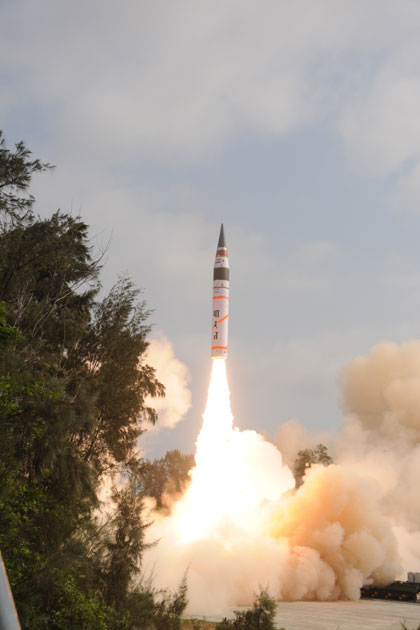
Trajectory of fire: Agni -5


The declared range is political. The demonstrated capability is not. Agni V truly epitomises the maturing of India's missile prowess and is a harbinger of many more technological successes to come. Far from being a "me too" effort to the P-5s (minus the UK) payload delivery systems, the solid-fuelled Agni V is a contemporaneous system exhibiting the state-of-the-art in ballistic missile developments. If production-ised quickly, it would give India the "omni deterrence" that one often hears in DRDOspeak.
Well, even if we look at the missile's stipulated range of "more than 5000 km", one finds that India now has the ability to hold all of China at risk from, say, the eastern states of India. But again, there is much more to this missile than its range capability. For one, the Agni V (like the Agni IV launched late last year) uses an extremely potent guidance package that utilises an indigenous ring laser gyroscope inertial navigation system (RLG-INS) coupled with a micro-inertial navigation system or MINGS. Both the RLG-INS and MINGS are capable of receiving multi-constellation updates from satellite navigation systems such as the American NAVSTAR GPS and the Russian GLONASS to remove accumulated errors in their measurements.
However, in the Indian scenario, foreign SATNAV systems cannot always be relied upon for targeting purposes and this feature of the Agni V's navigation system (i.e the ability to receive satellite updates) will come into its own once India establishes its own satellite navigation system. In the interim, it seems that some quarters in DRDO are confident that the combination of RLG-INS and MINGS, the latter being basically a MEMS-based miniaturised magnetometer, is capable of providing sub-200 metre circular error probable (CEP) accuracy at max range for the Agni V. Notably, this may improve considerably if a military grade signal from a SATNAV system can be used for updates.
In any case, the RLG-INS + MINGS guidance package represents a generational jump over older missiles in the Agni series which essentially use 1970s vintage INS coupled with a star-sighting system for navigation. There has even been speculation that the Agni II is capable of receiving updates from an earth station to remove accumulated errors. However, such a set up is naturally less accurate and prone to failures, as compared to the new navigation systems being used.
The superior accuracy of the Agni V can also be attributed to the incorporation of a much more powerful onboard computer. In the past, operating such processors came with weight and space penalties, given that the PCB based hardware enabling such processors consisted of myriad integrated circuits which resulted in the total weight of the onboard computer to reach almost 5 kg. However, Indian missiles will now incorporate system on chip(SOC) based computers that weigh just 200 grams and boast 6-7 times greater processor capability. The embedded SOC concept requires very little power and gives far greater leeway in warhead configuration besides enhancing efficiency.
Agni V is not just more accurate, but is also more reliable and indeed survivable. While its 2.0-m-diameter first stage motor is the same as that of the Agni III (which incidentally has gone into production recently) and made of 250 grade maraging steel, its second and third stages have carbon composite casings. This extensive use of carbon composites lowers the weight of the Agni V relative to a similar missile having only steel motor casings.
It also therefore facilitates greater fuel fraction, thereby enhancing range.
Now maraging steel certainly has very attractive features such as ultrahigh strength coupled with high fracture toughness, but comes with a weight penalty when contrasted with composites like glass reinforced plastic. Moreover maraging steel is also rather expensive compared to carbon composites and is naturally subject to the vagaries of nature via corrosion that carbon composites are not.
In the future, even the first stage of the Agni V may use carbon composite motor casings and that would take care of the issue of corrosion altogether and enhance overall structural integrity.
The Agni V also relies on digitally connected multi-channel communications within its body for the control system, thereby reducing a lot of the cabling that would have otherwise gone into these missiles. This serves to reduce the risk of failure in the missile system and increases dependability.
The use of corrosion-resistant composites and digital connectivity within the missile makes it easier in some sense to turn the Agni-V into the classic "wooden round" i.e a canisterised missile system transportable by road and rail ready to launch on demand. Indeed Agni V will be India's first canisterised long-range strike system and puts the country on the path to emulating Russia and China which operate similar road mobile missiles.

Now, while an Agni V locked and loaded sitting in a canister somewhere in India is not exactly what China likes to hear first thing in the morning, the middle kingdom could actually have more to worry about. The Agni V's re-entry vehicle a.k.a warhead shown in the released pictures may turn out to be rather maneuverable making things difficult for emerging Chinese terminal course anti-ballistic missile (ABM) defences. Indeed, an article in Global Times about the Agni V (for those who came late, Global Times is the Chinese Communist Party's tabloidish mouthpiece) may have indirectly acknowledged this when it quotes a Chinese analyst saying, towards the end of the piece, that "for the sake of regional stability, China should continue to develop defense systems against ballistic missile threats," and added that, "China successfully conducted its first ground-based mid-course ballistic missile interception experiment in January 2010, becoming the second country in the world to conduct this kind of missile defence test." Incidentally, the third stage of the Agni V is a conical motor which allows for greater acceleration in flight and makes it more difficult for mid-course interceptors to tackle it.
Ultimately, however, true strength will emerge out of efficacious production of the Agni V and it seems that progress has been made in this respect as well. For one, DRDO, via its government-owned company operated format (GOCO), has set up facilities that will now directly produce various components for the Indian missile programme that may not be available for import, or beyond the capabilities of the private sector.
Of course, the new Agni missile types in a way also show that the Indian private sector may now be coming into its own in defence production as evidenced by the fact that Premier Explosives based in Andhra Pradesh actually fabricated the composite casing for the second stage of the Agni IV.
Beyond composites, DRDO has also developed a new grade of low alloy steel designated DMR 1700 which can effectively substitute 250 grade maraging steel in missile applications, ranging from the skeleton to the 2.0 m diameter motor casing used in the first stage of the Agni V. DMR 1700 is significantly cheaper than maraging steel and may ensure that the production of strategic missiles advances quickly. So, although, we have waxed eloquent on composite motors, thus far an alternative for even more cost effective and quicker production probably exists.
In the next few years, the Agni V will be upgraded to carry multiple independently targetable re-entry vehicles (MIRV) and probably adapted for undersea launch. However, the development that I will truly look forward to is the emergence of the Agni V as an operationally responsive space launch system which essentially refers to the ability to put small satellite payloads into orbit on demand from the military. In an age where China is proliferating anti-satellite systems, that is one capability that India must certainly have.


Wednesday, 18 April 2012

BRICS Summit-2012(Coming of Age)


Leaders of BRICS, who met in Delhi on March 29, take steps towards achieving the summit's goals: “Global Stability, Security and Prosperity”.


THE fourth Brazil, Russia, India, China and South Africa (BRICS) summit, held in New Delhi on March 29, once again saw the leaders of the five emerging world powers share a platform and articulate common views on many of the burning issues facing the international community. Only some sections of the Indian media, taking a cue from the Western media, are trying to play down the importance of the BRICS grouping. The gist of their argument is that four of the member countries have an unequal relationship with China, the grouping's biggest economic power that will, it is being predicted, outgrow the United States by 2020. Sceptics in India and elsewhere have kept on saying that the grouping will be dominated by China. But as the speeches of the leaders at the summit and the Delhi Declaration that followed illustrated, BRICS can provide a win-win scenario, as Chinese officials say, for all the member countries.
The BRICS leaders are taking steps towards the achievement of the stated goals of the summit: “Global Stability, Security and Prosperity”. The groundwork has now been laid to further deepen cooperation among the five countries, which have the bulk of the world's population and much of its resources. Prime Minister Manmohan Singh said that despite member countries differing on some global issues, “there are many common interests that bind us all together”. In his opening speech, Manmohan Singh advocated speedy reforms in global international financial and political institutions and urged the BRICS grouping to work together to overcome the challenges posed by the global economic downturn. BRICS, he said, should work towards adopting a common position on issues relating to climate change, food security and trade linkages. “BRICS should also speak with one voice on important issues such as the reform of the United Nations Security Council,” the Prime Minister urged.
President Hu Jintao of China stressed the importance of “practical cooperation” between the member countries, keeping the goal of “common development and common prosperity” in focus. Senior Chinese officials said that the priority was to ensure the continuity of global economic reforms. The other BRICS leaders agreed that reforms were essential for the growth of the world economy and for the achievement of sustainable global development. Chinese officials emphasised that their government was committed to cooperation with developing countries “come rain or shine”. China was the first to propose the need to strengthen economic cooperation among BRICS countries. Chinese officials have suggested that senior officials from the grouping, including Finance Ministers and central bank Governors, meet on a more regular basis.
President Dilma Roussef of Brazil described BRICS as one of “the most important engines of the world economy”, pointing out that the countries of the grouping would be accounting for 56 per cent of the economic growth forecast by the International Monetary Fund (IMF) for 2012. She, like the other BRICS leaders, blamed the developed world for the “unjust growth policies” that brought about the current global economic crisis. Brazilian Trade and Industry Minister Fernando Pimentel said his country wanted the summit's final communiqué to contain language that would be critical of the monetary policies being pursued by the U.S. and western European countries. Brazil accused rich countries of causing a “monetary tsunami” by introducing low interest rates and bond-buying programmes.
The Delhi Declaration adopted at the end of the summit announced that the member states were exploring the possibility of setting up a common development bank. The Finance Ministers of the five countries have been tasked by their leaders to come up with a feasibility study on the proposed “South-South” bank before the next BRICS summit, to be held in Russia. The leaders indicated that the bank would be a counterweight to institutions such as the World Bank and the IMF, which continue to be under the dominance of the West. They resolved to work in unison to pressure the West into making the World Bank and the IMF more accommodative to the needs of the developing world. There were discussions among the leaders to support a candidate from a developing country for the top post in the World Bank. The leaders stated that they wanted the heads of the IMF and the World Bank to be selected through “an open and merit-based process”.
The BRICS nations decided to invest more in the United Nations Conference on Trade and Development, which has been focussing on the needs of developing countries. The other priorities they outlined were the Doha Development Agenda of the World Trade Organisation and the Millennium Development Goals of the U.N.
The BRICS nations have also agreed to promote trade in local currencies in order to reduce their dependency on the U.S. dollar and protect themselves from its volatility. Trading in local currencies will be conducted only through state-owned banks. This agreement is aimed at reducing the importance of the dollar and could be interpreted as the first step to challenge its supremacy. Standard Bank, the largest bank in Africa, in a recent report predicted that $100 billion in Sino-African trade would be settled in renminbi by 2015. South Africa is already taking steps to replace the dollar as the preferred worldwide currency for trade and investments in developing countries.
Foreign policy issues
Importantly, for the first time in the short history of BRICS, foreign policy issues were dealt with at considerable length in the Delhi Declaration. The BRICS leaders “recognised the vital importance that stability, peace and security of the Middle East [West Asia] and North Africa holds for all of us”. On Syria, the declaration said that the crisis there should be solved “through peaceful means that encourage national dialogues, which reflect the legitimate aspirations of all sections of Syrian society and respect the Syrian independence, territorial integrity and sovereignty”.
Russian diplomats were unhappy with India's vote in the U.N. Security Council on Syria and the recent vote in the U.N. Human Rights Council on the human rights situation in Sri Lanka. They have been calling for a unified stand by BRICS on key foreign policy issues. “A common position is needed on issues like Iran and Syria. The BRICS leaders should coordinate their positions at the summit,” said Alexander Kadakin, Russia's Ambassador to India. He pointed out that the threats to Iran by the West had led to shocks to the oil market, which adversely affected the economies of many developing countries. Russia and China had made the grievous diplomatic error of supporting the Security Council Resolution on Libya last year, which gave the West a carte blanche for regime change in that country. India had abstained on the Libya resolution.
On Iran, the BRICS nations cautioned against the escalation of the crisis, stating that it would have disastrous consequences. The leaders acknowledged Iran's “crucial role” in a region of “high political and economic relevance”. At the same time, the BRICS declaration recognised Iran's right to peaceful uses of nuclear energy “consistent with its international obligations”. It called for resolution of the Iran issue through “political and diplomatic means and dialogue”. The statements pertaining to Syria and Iran are important signals to the West that the BRICS nations are slowly but surely formulating a common stance on key foreign policy issues. The leaders stressed the importance of adhering to international law while tackling regional problems.
The Delhi Declaration called for a speedy resolution of the Palestine issue, implicitly calling on Israel not to use the “Arab Spring” upheavals as a pretext for not engaging in meaningful talks with the Palestinians. The statement noted that the unresolved Palestinian issue was one of the main underlying causes for the instability in the Arab world. On the issue of a reformed Security Council, Russia and China, while not openly endorsing the candidature of the other three members, “supported” their desire to play a more meaningful role in the U.N.
The Indian government took a tough stance with Tibetan exile groups who had planned large-scale protests in Delhi to coincide with the Chinese President's visit. A serious incident that took place before the arrival of the BRICS leaders in Delhi was the self-immolation of a young Tibetan activist. Chinese officials said that they were saddened by the death. They recalled that India was among the first countries to recognise the Tibetan Autonomous Region as part of China. They also said that the border talks between the two countries were going on satisfactorily.
The Indian Prime Minister had a 60-minute meeting with the Chinese President. The two sides agreed that there was a need to improve communication channels to further strengthen the goodwill that exists between the countries and to reduce scope for misunderstanding. The two leaders identified West and Central Asia and Africa as areas on which they could hold dialogue on a regular basis. The two countries are engaged in the hydrocarbon and mineral sectors in these regions. There is a seeming undercurrent of rivalry between the two resource-hungry nations as they scramble for oil and influence in Africa and Asia.


Courtsey::-Frontline(The Hindu)


Blogged By::-Rajesh_Patel
Preparing of Civil Services
E-Mail::-Rajesh.patelp@yahoo.com